This Toronto startup is diverting tonnes of building materials from landfill
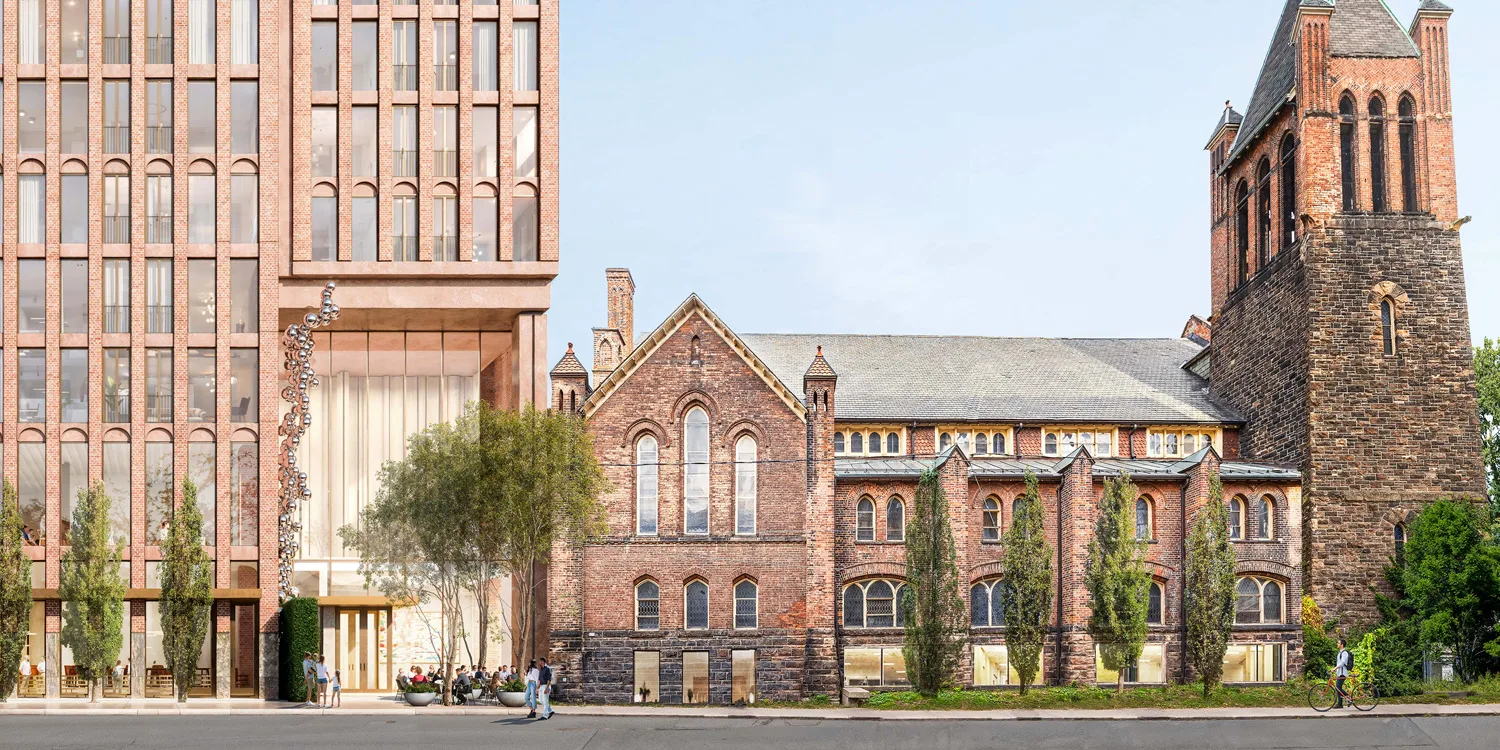
Canada generates 4 million tonnes of construction waste a year. Adaptis helps building managers salvage and reuse materials while also reducing carbon emissions.
In 1892, the Walmer Road Baptist Church was the largest Baptist church in Canada and a landmark in Toronto’s Annex neighbourhood, renowned for its blend of Romanesque and Queen Anne Revival architecture. Over the next few years, as new buildings were added to the structure, it became even more of a focal point of the community, home to the country’s first co-located daycare, a food bank and a theatre.
By the early part of this century, however, the church was in desperate need of repair and, with the congregation having dwindled from 1,500 to less than a hundred, had few resources at its disposal.
In 2020, the church joined forces with progressive real estate developer TAS to reimagine the site. After a couple of years, they arrived at a design that would include a new, more compact church, a restoration of the existing sanctuary that would add two floors of commercial and community space, as well as a 25-storey condo tower. To make room for all this, however, the chapel, Sunday school and a structure linking these to the sanctuary would have to be demolished. This redesign would result in hundreds of tonnes of waste, all of which would end up in Toronto landfills.
Or at least it normally would.
In the last four years, in order to both shrink their carbon footprint and cut costs, TAS has made a concerted effort to, as CEO Mazyar Mortazavi puts it, “optimize our material reuse.” That usually means deconstruction — i.e., carefully dismantling a building and salvaging its materials for repurpose or recycling. TAS began this optimization with its 2 Tecumseth Street project, where Mortazavi says they managed to divert more than 90 percent of demolition waste from landfill.
At Walmer Road, the company had even more help — in the form of Toronto startup Adaptis. Sheida Shahi founded the company in 2022 to help the building and construction industry reduce its environmental impact. Its primary product is an AI-powered platform that can assess the entire life cycle of a building in just a few hours, giving property owners, architects and developers a complete picture of a building’s performance. The platform provides details of a structure’s materials — their weight, cost and value, and the amount of carbon dioxide released creating them — and data on the emissions released heating and cooling it. This information, which is normally time consuming and difficult to obtain, helps asset stakeholders make more cost-effective, environmentally informed decisions.
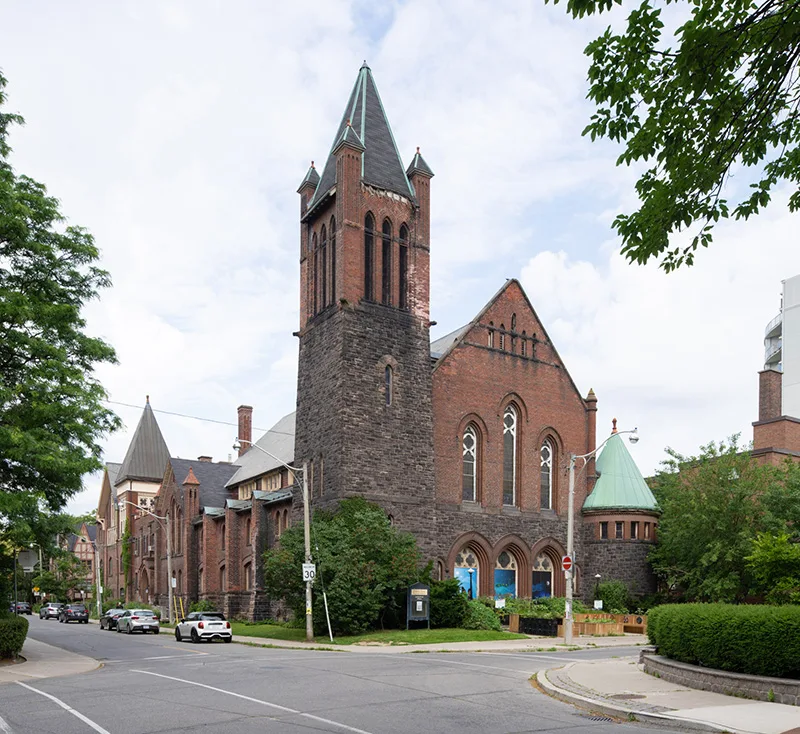
Toronto startup Adaptis conducted a detailed analysis of Walmer Road Baptist Church using 3D modelling, site measurements and historical drawings.
“It’s just making sure we don’t waste more than we need to,” says Shahi.
Decarbonization is critically important for a sector struggling to get its GHG emissions under control. Currently, the building and construction sector is responsible for 37 percent of global emissions. Reducing those emissions requires retrofitting existing buildings while also constructing new ones in a carbon-neutral way. This is particularly challenging given the unprecedented growth we face: Between 2020 and 2060, the world is expected to add about 2.6 trillion square feet of new floor area — the equivalent of building an entire New York City every month — for 40 years.
Building emissions come in two forms: embodied (released in the manufacturing and transport of the materials and construction), which can account for as much as 85 percent of a building’s emissions, and operational (generated by a structure’s function and maintenance — lighting, cooling, etc.).
Carbon’s not the full story, either; there are many other deleterious effects that accompany the creation of materials: air pollution, the disfigurement of land, unsustainable water use. Concrete and steel production are particularly pernicious: the former’s production is responsible for about 9 percent of industrial water withdrawal worldwide and steel mills can generate dangerously high levels of toxic air pollutants, most notably benzene.
“If there’s value in the resource, the resource should be used as best we can, to avoid primary production,” says Steven B. Young, an industrial ecologist and professor at the University of Waterloo. “Because most of the impacts — the greenhouse gas impacts, the particulate impacts, the toxicity impacts — occur in primary production.”
Sheida Shahi’s been working on this problem throughout her career. A registered architect, she spent several years on adaptive reuse projects — “I found dealing with existing chaos and putting order into it really interesting,” she says. But she felt the data collected during those projects could be used much more effectively to cut carbon and costs. To that end, in 2017, she returned to the University of Waterloo (where she received her architecture degree) to complete a PhD in circular engineering. As part of a multi-university research group, she explored methodologies and strategies for implementing circularity in buildings.
“When we make design decisions early on, we can’t just look at the immediate needs of a building,” she says. “We need to look at what the building needs way down the line.”
This research informed the development of a smart platform that enables and encourages circularity — that is, conserving resources, minimizing waste and keeping materials in circulation. By running thousands of simulations through its AI model, Adaptis can determine exactly how much it would cost, both in dollars and emissions, for a building owner to optimize for various targets, such as reducing operational carbon, embodied carbon and end-of-life carbon, through salvage and reuse of materials.
Earlier this year, for a proposed mid-rise residential development in Brampton, Adaptis analyzed the baseline design provided by the building owner against alternatives that optimized HVAC systems, water heating and envelope improvements. Even though construction hadn’t even begun, assessing early material and design choices, as well as what could happen to the building once it reached the end of its life, was instructive. The optimal design Adaptis came up with saved 68 percent in operational carbon, and by planning for eventual material recovery and reuse, no matter how far in the future that might be, a 42 percent reduction in net embodied carbon emissions.
In the past, asset stakeholders had to rely on outdated architectural drawings and multiple site visits from different consulting teams to determine a building’s carbon footprint. Adaptis’s platform can do this same work 20 times faster, enabling a 20 percent savings in capital expenditures.
Given skyrocketing construction costs and evolving building codes, the platform had instant appeal. Between 2023 and 2025, the company doubled its revenue, and expanded into B.C., Washington and New York. So far, it’s raised U.S.$5.5 million and is working on 600 buildings in Canada, U.S. and Brazil, with an additional 200 in their pipeline.
“This type of technology helps improve speed, as well as awareness of materials,” says Raphael Lopoukhine, director of strategic initiatives at Circular Economy Leadership Canada. “So you’re looking at material efficiency improvements, time improvements and then general enhancement of productivity in the industry.”
Circularity also, of course, prevents waste from ending up in already overburdened landfills. Canada currently produces more than 4 million tonnes of construction waste every year, with more than 80 percent of it going to landfills. Adaptis claims that it’s diverted more than 6,000 tonnes of waste so far, avoiding 108,000 tons in carbon emissions.
At the Walmer Road Baptist Church, they’ll save even more. That process began with a detailed analysis of the structure’s materials using 3D modelling, site measurements and historical drawings to quantify what existed on site. Then Adaptis developed an assessment that ranked components by how easily they could be repurposed, reused or recycled. Out of that came four “end-of-life” scenarios that enabled TAS to compare reuse potential and emissions savings against standard demolition approaches.
Those scenarios showed that, by reusing existing materials, they could potentially divert 922 tons of material, and, with recycling factored in, avoid 250,000 kg of emissions before construction even begins. They also determined that full demolition, when accounting for landfill fees, was the most expensive option. “It’s only once you have the data and the information that you can break it down and show there’s actually a cost savings here for everyone,” says TAS’s Mortazavi. “And so you begin to reframe this [material reuse] not as a cost centre but actually as a savings.”
While still waiting on final city approvals, TAS expects to begin deconstruction within the next 12 months, and it will be the firm’s first development to reintegrate a significant amount of reclaimed material — church pews, stained glass, a million kilograms of bricks — directly into the new build.
“The end of a building’s life is as important as the start,” Shahi says. “The key is planning.”
Adaptis is one of six companies in Mission from MaRS: Better Buildings Adopting Accelerator, which was made possible by the Peter Gilgan Foundation. This special initiative aims to accelerate the adoption of Canadian innovations that help decarbonize existing structures and construct better ones. Applications for the second cohort are being accepted until January 23, 2026.
Photos courtesy of TAS
 Jason McBride